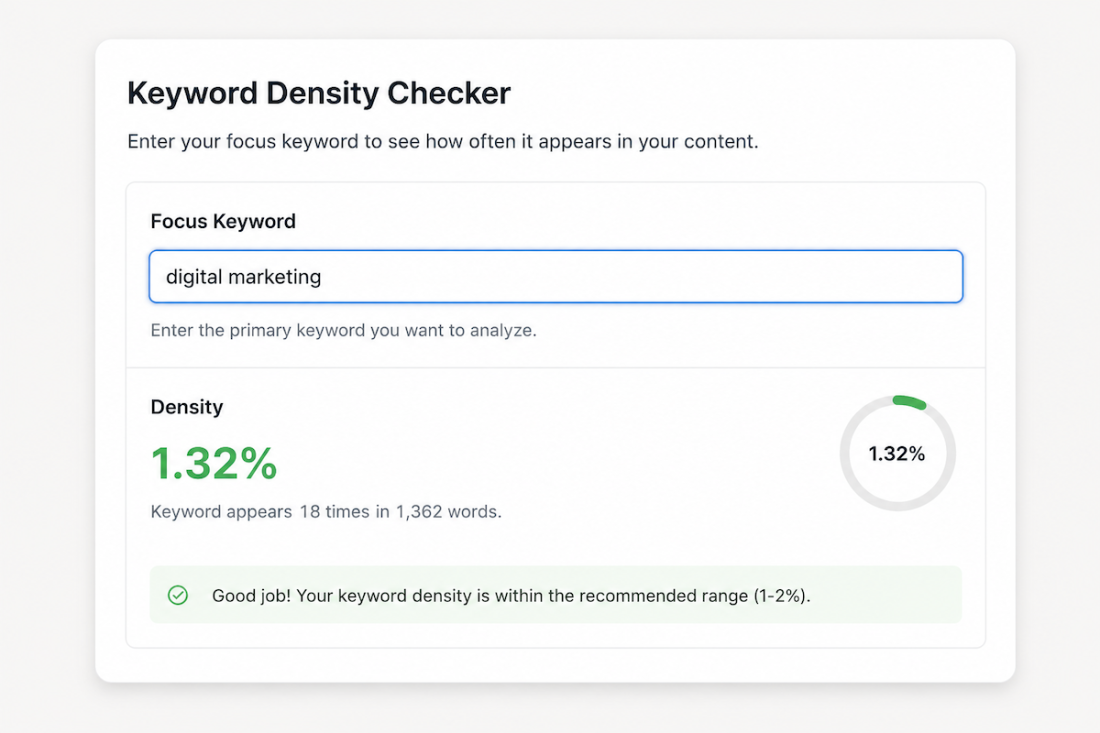
You probably found this page after seeing the name Zuhio keyword count checker somewhere and wondering whether it is real and worth your time. Here is the short version. It is presented as a free, no-signup web tool that counts how often your target keyword appears in your writing and works out its density as a percentage. It does that one job, and for a fast check that can be genuinely useful.
The catch is that there is no single official Zuhio to point to — the tool is written about across many independent blogs rather than sitting at one clear home. So treat it like any small free utility: fine for a quick look, as long as you know what you are using. This review covers what it does, whether you can trust it, and when a named tool serves you better.
What Is the Zuhio Keyword Count Checker?
The Zuhio keyword count checker is a web-based tool that counts how many times a specific keyword appears in a block of text and calculates that word’s density as a percentage of the total. You paste your content in, tell it the term you care about, and it returns a raw count alongside a density figure.
Those two numbers measure different things. Keyword count is simply the tally — your phrase shows up eleven times. Keyword density is that tally expressed as a share of the whole piece, so eleven uses in a 2,000-word article works out to roughly 0.55 percent. Density is the more useful of the two, because a raw count means little without knowing how long the text is. Five mentions in a 300-word post is heavy. Five in 3,000 words barely registers.
One thing is worth knowing up front. Zuhio is described across a range of independent blogs rather than from a single product page. That does not make it useless, but it does shape how you should treat it — which the next section covers.
Is Zuhio Legit, Free, and Safe to Use?
These are the questions worth asking about any tool you have not used before, and they matter a little more when the tool has no obvious owner.
Is there an official Zuhio website?
Not one that can be verified. Search for Zuhio and what comes back is a long list of blog posts explaining the tool, not a company site, an app, or a product homepage. In practice that means any page offering the Zuhio keyword count checker is most likely running its own version of a simple density checker under the name. That is not sinister — plenty of small web tools work this way — but it does mean there is no central version to bookmark and no maintainer standing behind it.
Is it actually free?
Every description of it says the same thing: free to use, with no signup or account required. That matches how these lightweight checkers usually operate. The only caveat is that, with no single official version, exactly what you get depends on whichever site is hosting the one you land on. Free is the norm here, just not a guarantee you can hold anyone to.
Is it safe to paste your content into?
For text you are happy to share, it is fine — a keyword checker only reads the words you give it. The sensible line to draw is around unpublished or client-sensitive work. Pasting a draft that has not gone live, or anything covered by a client agreement, into an anonymous tool with no named operator is a small risk you do not need to take. For that kind of material, use a checker with a clear owner and a privacy policy you can actually read. For a blog post that is already public, paste away.
How to Use the Zuhio Keyword Count Checker (Step-by-Step)
Using it takes about a minute. The steps below apply to the Zuhio keyword count checker and to more or less any density tool of the same kind, so they hold whichever version you end up on.
- Prepare your text. Have the piece you want to check ready, ideally a near-final draft rather than a rough outline. The count only means something once the content is close to done, since edits shift both the tally and the density.
- Paste it into the tool. Drop the full text into the input box. Most checkers of this type read plain text, so you do not need to strip formatting, though stray code or HTML can occasionally inflate the count.
- Enter your target keyword. Type the exact phrase you are optimising for, not just its root. If you care about “keyword count checker,” enter that whole phrase — “checker” on its own returns a different, much larger number.
- Run the check and read the results. The tool returns a raw count and a density percentage. Note both, but pay more attention to the density figure, since it is the one that accounts for how long your piece is.
- Adjust naturally where needed. If the density looks high, swap some exact-match uses for synonyms or related phrases. If it looks thin, work the term into a heading or a sentence where it genuinely fits. Change the writing, not the count for its own sake.
That is the whole loop. The value is not in the number itself but in what it prompts you to do — write the way you would anyway, then check you have not drifted into over-using the phrase or forgetting it entirely.
What the Results Mean: Keyword Density That Actually Helps
Once you have a density figure, the obvious question is what a good one looks like. The honest answer is that there is no magic number, and any tool implying otherwise is overselling. Google stopped rewarding keyword density as a ranking lever a long time ago; it reads meaning now, not ratios. What the figure is genuinely good for is catching the two failure modes — a term hammered so often the writing turns robotic, or one used so rarely the page never clearly signals its topic.
As a loose guide rather than a target to hit, the ranges below tend to sit in comfortable territory for most content. Treat them as a sanity check on writing you have already done naturally, not a quota to write toward.
| Article length | Sensible times to use the keyword | Rough density |
|---|---|---|
| 500 words | 3 to 5 | ~0.6 to 1% |
| 1,000 words | 5 to 8 | ~0.5 to 0.8% |
| 2,000 words | 8 to 14 | ~0.4 to 0.7% |
Notice the percentage drifts down as the piece gets longer. That is deliberate. A natural writer repeats the exact phrase less as they gain room for synonyms and related ground, so a healthy density on a long article is lower than on a short one. If your draft lands near these figures, leave it alone. If it is wildly over, that is usually a sign of forced phrasing worth loosening — and catching that is the most useful thing a density check will ever do for you.
What Zuhio Does Well, and Where It Falls Short
Taken for what it is, Zuhio has real strengths. It is fast, it costs nothing, it asks for no account, and it does its single job without clutter. There is nothing to install and nothing to learn. If all you want is to glance at how often a phrase appears, that simplicity is a genuine virtue — you are not booting up a whole platform to answer one small question.
The limits are the flip side of the same simplicity. It does one thing, so it tells you nothing about search volume, competition, or how rivals cover the topic. It keeps no history, so there is nothing to track over time. And because no named party maintains it, there is no support, no changelog, and no promise the version you used last week behaves the same today. None of that is damning for a free spot-check. It just means Zuhio is a convenience, not a foundation to build a workflow on, and you outgrow it the moment your needs get serious.
Zuhio vs Tools You Can Rely On
If you find yourself reaching for a density checker often, it is worth knowing what a named alternative buys you. The table below sets Zuhio against two categories of tool you can actually verify and stand behind.
| Tool | What it is | Best for |
|---|---|---|
| Zuhio Keyword Count Checker | A free density checker with no verified owner | A quick throwaway spot-check |
| SEO Review Tools Keyword Density Checker | A free, named density tool from an established SEO-tools site | Regular free checks you can trust |
| Semrush or Ahrefs | A full SEO suite with keyword, SERP and competitor data | Serious optimisation work |
Zuhio wins on nothing but speed and the fact that it asks nothing of you. For a one-off glance it is fine, and there is no shame in using it that way.
A named free checker such as SEO Review Tools’ keyword density tool does the same job with an owner behind it, a privacy policy, and a version that stays put. If you run checks with any regularity, that reliability is worth having at the identical price of nothing. You get the same number and someone accountable for the tool that produced it.
A full suite like Semrush or Ahrefs is a different order of tool entirely. Density is a footnote in what they do — they show you what to write about, who you are up against, and whether a published page is actually working. You pay for that, and for real optimisation work it earns its keep. Choosing between the three is really a question of how much the answer needs to be trusted.
Who Should (and Shouldn’t) Use It
Zuhio suits anyone who wants a fast, free density figure and nothing more — a blogger checking a finished post, a student glancing at an essay, someone simply curious whether they have overused a phrase. If that is you, it does the job and you can close the tab a minute later.
It is the wrong tool if you handle client content, need results you can trust and revisit, or want any insight beyond raw frequency. Agencies, serious content teams, and anyone whose work depends on the number being right should reach for a named checker or a full suite instead. The line is simple: casual and disposable, Zuhio is fine; anything that matters, use something with a name on it.
Frequently Asked Questions
Is the Zuhio keyword count checker free? Yes. Every version of it is described as free to use with no signup or account needed. Just be aware that, since there is no single official tool, what you get depends on the site hosting the one you open.
Is it safe to use? For public or shareable text, yes — it only reads what you paste in. Avoid feeding it unpublished drafts or client-sensitive material, though, because there is no named operator or privacy policy behind it. For anything confidential, use a tool with a clear owner.
Is there an official Zuhio website? None that can be verified. Searching for it turns up blog posts explaining the tool rather than a company site or product page, which suggests any working version is an independent build rather than one central product.
What keyword density should I aim for? There is no ideal figure. Roughly 0.4 to 1 percent tends to read naturally depending on length, but modern search rewards clear, natural writing over any target. Use the number to catch over-stuffing, not as a goal.
Does keyword density still matter for SEO? Less than it once did. Google no longer ranks pages by hitting a density ratio, so it is not something to optimise toward. It still helps as a check — a quick way to spot writing that has drifted into repeating a phrase or ignoring it entirely.
What are the best alternatives? For a free, named option, SEO Review Tools’ keyword density checker does the same job with an owner behind it. For fuller insight — keyword research, competitor data, and on-page guidance — Semrush or Ahrefs are the established choices.
So, Is the Zuhio Keyword Count Checker Worth It?
For what it is, the Zuhio keyword count checker is worth a quick check. If you land on a working version and just want to see how often a phrase appears and what that works out to as a density, it answers the question in seconds and costs nothing. Used that way, it is a small, handy utility.
Where it stops being the right choice is anything that matters. The lack of a verifiable owner, saved results, or any data beyond raw frequency means it is not something to build a real workflow on. For regular checks, a named free tool does the identical job with someone standing behind it; for serious optimisation, a full suite is the better home. Use Zuhio for the glance, and something with a name on it for the work.