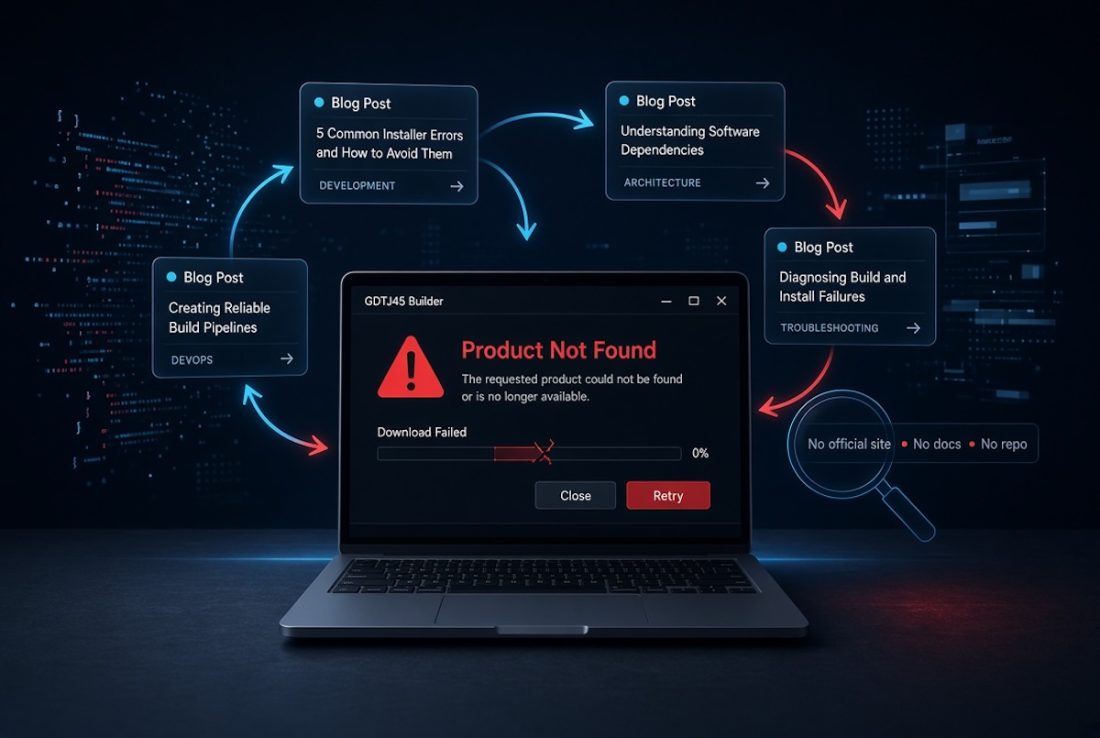
If you are here because GDTJ45 builder software will not install, keeps failing, or has left you staring at a guide that does not match anything on your screen, there is a reason no fix has worked. There is no product to fix.
No official website exists for it. No documentation, no pricing page, no repository, no company. It does not appear on any of the platforms where software is normally listed and reviewed. The many articles describing its features cite nothing except each other.
This guide covers why your install is failing, what the term is claimed to be, how anyone can verify that for themselves, what to do if you have found the string in your own code or logs, and which real tools do the job GDTJ45 is supposed to do.
Why Your GDTJ45 Install Isn’t Working
The symptoms people report are remarkably consistent. The download link goes nowhere or produces a file that will not run. The installation fails partway with an error nobody else has documented. The configuration steps reference menus and settings that do not exist. The interface in the screenshots does not match anything you can open.
All of these have the same cause, and it is not you.
This is worth saying plainly, because the natural assumption when software will not install is that you have made a mistake. You have followed a guide that was written about a product the writer had never used, and quite possibly could not have used. No amount of care on your part would have produced a different result.
It is also why the troubleshooting articles do not help. There are several of them, offering fixes for crashes and broken configurations, and they are written with exactly the same confidence as the guides that sent you looking in the first place. A fix guide for a product that does not exist can only ever describe generic remedies. Clearing a cache, reinstalling, checking permissions. None of it addresses the actual problem, because the actual problem is upstream of anything on your machine.
If you have lost an hour to this, you have lost an hour to a search result rather than to a mistake. That is a frustrating answer, but it is a better one than continuing to troubleshoot.
What GDTJ45 Builder Software Is Claimed to Be
The descriptions circulating are detailed and technically plausible, which is precisely why the term has spread so effectively.
Most articles present GDTJ45 as a modular development platform. Drag-and-drop visual design combined with the ability to drop into custom code. Support for JavaScript, Python and Java. Integration with version control. Real-time collaboration for teams. Rapid prototyping for startups and internal tooling for larger organisations.
Read one of those articles in isolation, and nothing sounds wrong. Every capability described belongs to a genuine category of software, and several real platforms do exactly these things.
The problem appears when you read several articles together. One describes a no-code application builder. Another describes a collaborative code editor. A third describes project management software. At least one describes something closer to a construction planning tool. These are not different emphases on one product. They are different products.
Real software maintains a stable identity. A platform’s core function, its target user and its positioning do not change depending on which blog is describing it.
The claims that don’t hold up
The statistics are the clearest signal, once you know to look at them.
Articles about GDTJ45 quote development speed improvements in the range of forty to sixty per cent. Some cite millions of active users, or millions of code snippets processed each month, or a precise number of hours saved per developer per week.
Numbers that specific normally have a source. A company publishes them in a case study, an analyst measures them, a benchmark produces them. These have none. They appear without attribution, and the same figures recur across unrelated websites in near-identical phrasing.
When several independent publications quote identical unsourced statistics about a product, they are not reporting on the product. They are copying each other.
How We Know It Isn’t Real
You do not have to take anyone’s word for this, including ours. The checks take about five minutes, and they work on any unfamiliar tool.
There is no official homepage. Every genuine software product has one, with at minimum a description, a pricing or licensing page and a way to download or sign up. Searching for GDTJ45 returns articles about it and nothing from anyone who makes it.
There is no documentation. Real development tools publish reference docs, installation guides and release notes, because their users cannot function without them. None exists here.
There is no repository. A modular development platform supporting multiple languages would have a public presence on a code hosting service, whether open source or simply for issue tracking. There is nothing.
It appears on no review platform. Software of this description gets listed on the major review and discovery sites as a matter of course, because vendors want to be found. Searching those platforms returns no verified result.
No company owns the name. There is no vendor, no trademark registration, no team page, no support contact.
Every source points to another article. This is the decisive one. Follow the citations on any page describing GDTJ45 and they lead to other pages describing GDTJ45, never to a manufacturer, a filing or a primary source. A closed loop of articles referencing each other is not evidence. It is the absence of evidence, arranged to look like the opposite.
If You Found GDTJ45 in Your Code or Logs
This is a different situation from idle curiosity, and it deserves a proper answer rather than reassurance. An unfamiliar string appearing somewhere you did not put it is worth understanding.
Work out where it came from
Most of the time the explanation is mundane. Someone copied a snippet from an article. An AI coding assistant suggested a package name it had absorbed from the same content that produced these articles, which happens more often than people expect. A colleague read a guide and typed what it told them to.
Start with your version control history. Find the commit that introduced it, see who made it and what else changed alongside. That usually answers the question in under a minute, and it tells you whether this was a person or a process.
Audit your dependencies
If the string appears in a dependency file rather than in a comment or a variable name, check whether anything actually resolved and installed.
Open your lockfile and see whether an entry exists for it. Compare what is installed against what your manifest declares. If something did install, look up the registry entry and check the maintainer, the publish date and the download count. A package published recently by an account with no history, carrying a name you only encountered in a blog article, deserves scrutiny.
If nothing resolved, the reference is inert. It is untidy rather than dangerous.
When to be genuinely concerned
Proportion matters here. A string sitting in a comment, a README or an unused variable is a piece of litter. It cannot do anything.
A package that resolved, installed and ran a post-install script is a different matter, and worth treating as a genuine incident: check what it executed, rotate any credentials that environment had access to, and raise it with whoever handles security where you work.
The broader lesson is worth carrying regardless. Package names taken from articles rather than from official documentation are a known route for malicious code, because attackers register plausible names and wait. Verify a package against its project’s own documentation before installing it, every time.
Why You Can’t Edit the Code
A number of people arrive at this looking specifically for how to edit code in GDTJ45 builder, usually after reading that it combines visual building with custom code editing.
There is no editor, because there is no application. There is no source to modify, no configuration file to adjust and no project structure to work within. Guides describing the editing workflow are describing an interface nobody has seen.
What people looking for this usually want is real enough, though, and worth naming. They want a visual builder that does not trap them: something that generates a working application quickly, but lets them drop into actual code when the visual layer runs out of road. That combination is the whole point of the low-code category, and several genuine platforms deliver it.
If that is what brought you here, the last section of this article is the one you want.
How This Happens, and How to Spot the Next One
The mechanism is not mysterious, and understanding it is more useful than knowing about this one term.
An invented product name enters circulation. Content is generated about it at volume, quickly and cheaply, describing capabilities borrowed from real tools in the same category. Search engines index that volume before anyone has published a correction, because the correction only becomes worth writing once the fabrication has traction.
Each new article cites the existing ones. To an automated system, and to a reader in a hurry, a dozen sources agreeing looks like consensus. It is actually one claim reflected in a dozen mirrors.
GDTJ45 is not unique. Similar fabricated technical identifiers have circulated in the same period, following the same pattern and drawing the same kind of traffic.
The checklist that catches all of them is short. Does an official homepage exist? Is there documentation? Is there a repository or a listing on a review platform? Is there a company with a name and an address? And when you follow the citations, do they lead to a primary source or back into the same circle of articles?
Five questions, five minutes. Run them before you install anything you first heard about in a blog post.
What to Use Instead
If you came looking for a modular builder that mixes visual design with real code, these platforms exist, have documentation, and can be evaluated properly.
| Tool | Best for | Open source? | Worth knowing |
|---|---|---|---|
| Retool | Internal tools built on existing databases and APIs | No | Fastest route to an internal dashboard; drop into JavaScript wherever needed |
| Appsmith | Internal tools where you want to self-host | Yes | Similar territory to Retool, with a self-hosted option |
| Budibase | Internal apps and simple CRUD workflows | Yes | Lighter to get started with; smaller ecosystem |
| Bubble | Full web applications without writing code | No | Genuinely no-code, so less useful if you want to write code |
| FlutterFlow | Mobile applications, visually built | No | Exports real Flutter code you can take away |
| OutSystems | Enterprise applications at scale | No | Powerful and heavyweight; priced for organisations |
The honest way to choose between them is by what you already have. If your data lives in a database or behind APIs and you want a usable interface on top of it quickly, Retool or Appsmith will get you there in an afternoon, and the choice between them mostly comes down to whether self-hosting matters to you.
If you are building something customer-facing rather than internal, Bubble covers web and FlutterFlow covers mobile. FlutterFlow has the useful property of exporting real code, which means you are not permanently dependent on the platform.
OutSystems belongs in a different conversation, one that usually involves procurement. It is capable, and it is not something you trial on a Tuesday afternoon.
All six have documentation, pricing, support and users who will tell you what went wrong. That is the difference, and it is the only difference that matters.
Frequently Asked Questions
Is GDTJ45 builder software real?
No verified evidence supports it. There is no official website, documentation, repository, company or listing on any recognised software platform, and the articles describing it cite only one another.
Why won’t GDTJ45 builder software install?
Because there is nothing to install. Failed downloads, broken setups and instructions that do not match your screen all have the same cause, and no troubleshooting step will resolve it.
Where can I download GDTJ45 builder software?
Nowhere legitimate. Treat any site offering a download for it with real caution, since unfamiliar product names are a known route for delivering unwanted software.
Can I edit code in GDTJ45 builder?
There is no editor and no source to edit. If you want visual building with the option to write real code, the low-code platforms listed above provide that combination.
Is GDTJ45 dangerous?
The name itself cannot harm you. The risk sits in download links and package names attached to it. A string in a comment is harmless; a package that actually installed is worth investigating.
Why do so many websites write about it?
The term attracts steady search traffic, which makes it worth publishing about. Articles were generated at volume and indexed before any correction existed, and each one citing another created an appearance of consensus.
What should I use instead?
Retool or Appsmith for internal tools; Budibase if you want something lighter and self-hosted; Bubble for web apps; FlutterFlow for mobile; OutSystems for enterprise scale. All are real and documented.
How do I check whether software is real before installing it?
Look for an official homepage, documentation, a repository or review-platform listing, and an identifiable company. Then follow the citations. If they lead only to other articles, stop.
The Short Answer on GDTJ45 Builder Software
It is not working because GDTJ45 does not exist. No installer, no editor, no configuration, no fix. If you have spent an evening troubleshooting it, the fault was never at your end.
If the string turned up in your own code, check the commit that introduced it and your lockfile. In most cases it is litter rather than a problem, and now you know how to tell the difference.
And if you came here wanting a builder that mixes visual design with real code, that tool does exist. Several of them do, with documentation you can read and users you can ask. Pick one of those and you will spend your evening building something instead.